Budget for towing, downtime, and the repair exit cost
Separate the repair bill from transportation, payment timing, storage, and the cost of declining after diagnosis.
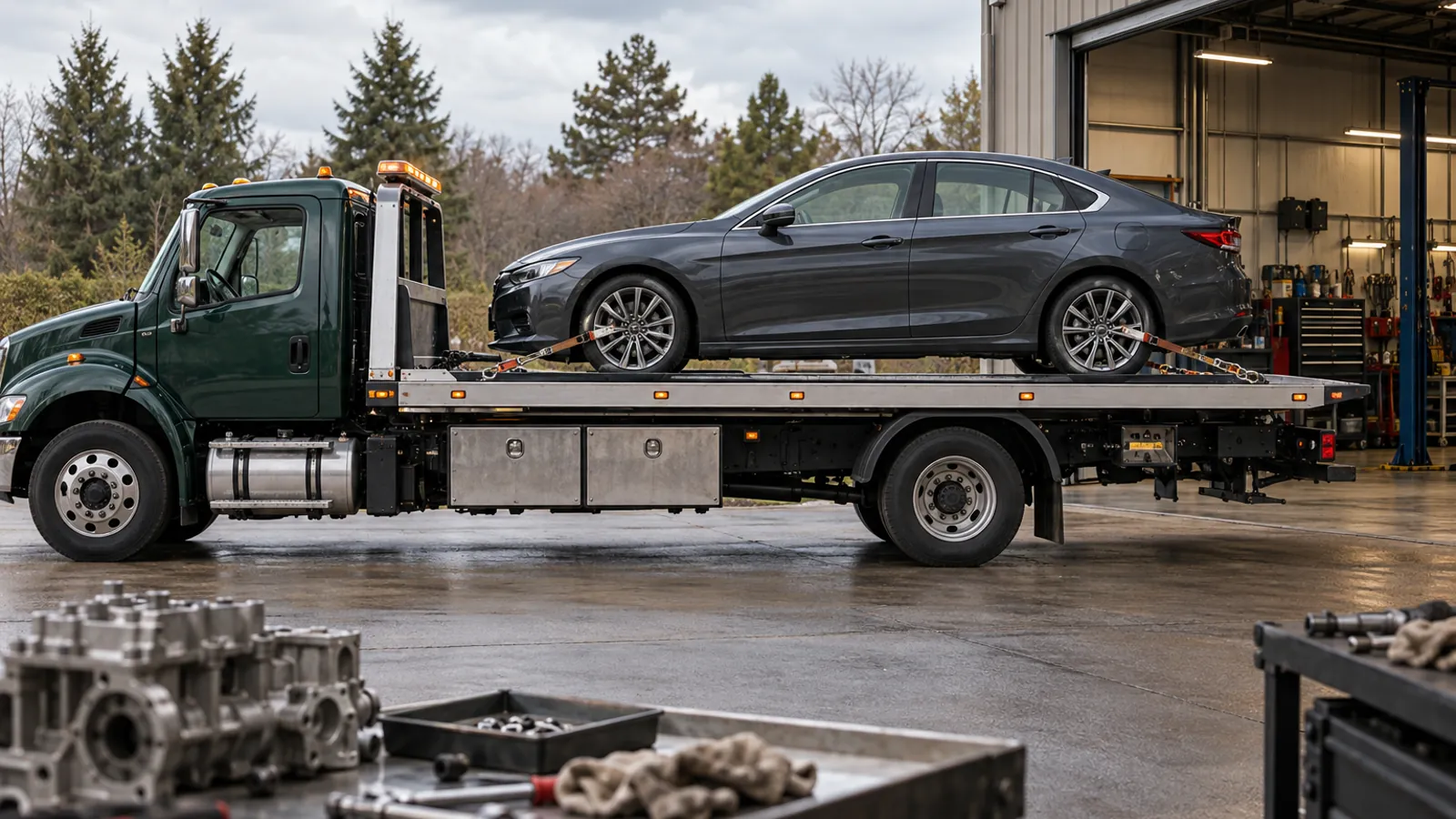
A major repair decision needs both the installed-job total and the broader cash budget while the vehicle is unavailable. Keep towing, temporary transportation, deposits, storage, and possible reassembly costs distinct. This prevents a low assembly price from hiding the practical cost of getting through the repair. It also helps you avoid counting a charge twice when the shop already includes it.
Ask first whether the vehicle should be driven. Follow the manufacturer’s instructions and a qualified professional’s guidance rather than using a cost worksheet to justify a risky trip. Towing price, destination, vehicle condition, and pickup arrangements should be confirmed with the actual provider. This site does not offer towing or assess whether a particular vehicle is safe to move.
Map the timing of cash
List what is due now, what is due at pickup, and what may be refunded later. A deposit paid toward the job affects the remaining balance, while a core deposit can affect both initial cash needs and the eventual net cost. Keep the conditions attached to every expected credit.
| Budget line | Timing question |
|---|---|
| Diagnostics | Due even if repair is declined? |
| Parts deposit | Refundable under what conditions? |
| Core deposit | Who returns the core and receives credit? |
| Transportation | Daily, weekly, or fixed terms? |
| Storage | When does the charge begin? |
Do not assume a manufacturer, contract administrator, or insurer will reimburse a cost. Ask for coverage and approval requirements before incurring the expense, and keep any authorization number or written response.
Use a downtime scenario, not a prediction
Suppose an illustrative repair subtotal is $4,000, towing is $120, and you plan for 5 days of transportation at $40 per day. The broader pre-tax scenario is $4,000 + $120 + 5 × $40 = $4,320. These are fictional planning inputs, not actual rental rates, repair prices, or a promised completion period.
If the delay extends to 9 days under the same hypothetical daily assumption, transportation becomes $360 and the broader total becomes $4,480. Real rental charges may include taxes, insurance, mileage limits, or other terms, so use an actual written offer. A daily multiplication is only a scenario. Ask the repair shop what depends on parts availability and when it will communicate a delay.
Know the cost of declining
If the vehicle has been disassembled, declining final repair may still leave agreed diagnostic, teardown, reassembly, towing, or storage charges. Ask about these before authorizing access work. Find out whether the vehicle can be transported in its current condition and what the receiving shop would need.
Do not assume moving the vehicle is always the cheapest way to get another opinion. Compare the exit cost, new diagnostic work, transport, and the uncertainty of a second proposal. On the other hand, sunk diagnostic spending should not automatically force you into a repair whose necessity or scope remains unclear. Separate the money already committed from the new work you are being asked to approve.
Keep the budget separate from financing promises
If you consider paying over time, read the actual financing agreement and compare the total cost, fees, due dates, and consequences of missing payments. This page does not recommend a credit product or calculate an individualized affordability limit. Do not assume a small periodic payment makes a repair economically sensible or that a promotional term applies without conditions.
For the repair itself, use a documented spending cap and ask how extra work is approved. A personal reserve is not permission for the shop to spend it. Keep transport receipts and coverage decisions in the same folder as the estimate. If the wider budget makes the proposal unaffordable, discuss the next stage and exit terms before the vehicle accumulates additional agreed charges.
Plan for the first delay update
Ask when you should expect the first progress update and what information the shop can provide if parts are delayed. A useful update identifies the dependency, the current plan, and whether any approval is needed. It does not need to invent a definite pickup date when the supplier has not confirmed delivery.
For temporary transportation, use the real provider’s cancellation, extension, mileage, and payment terms. If you are depending on warranty reimbursement, ask for the actual coverage limit and approval requirements. Do not assume that every day the vehicle is at a shop is reimbursable.
If a delay materially changes affordability, speak with the shop before authorizing further work or extending other services. Keep personal transport choices separate from the shop’s obligations unless a written agreement connects them. This makes it easier to understand which costs are under your control and which questions require a provider’s answer.
Questions before you decide
Is downtime part of the shop price?
Usually it is a separate planning issue unless the proposal explicitly includes transportation. Check the actual terms.
Can I assume the core refund pays for pickup?
No. It may occur later and depends on acceptance. Plan initial cash separately from eventual net cost.
Should I move the vehicle for a cheaper quote?
Compare towing, exit charges, repeat diagnosis, and the completeness of the second proposal before deciding.
Continue with the same decision
- How to read an itemized repair estimate
- Compare two repair estimates without losing the scope
- A transmission estimate worked through line by line
- Compare repair approaches
- Use the total worksheet
Official sources and limits
- Federal Trade Commission — Auto Repair Basics — written estimates, repair terminology, and warranty questions.
Source links checked October 30, 2026. Dollar examples are illustrative, not surveyed prices. State-specific requirements are labeled and must be checked for the location of your repair. No licensed mechanic or attorney has reviewed this guide.